Terra Incognita: Restoring the Wilderness as a Living, Breathing Antagonist in Your Campaign
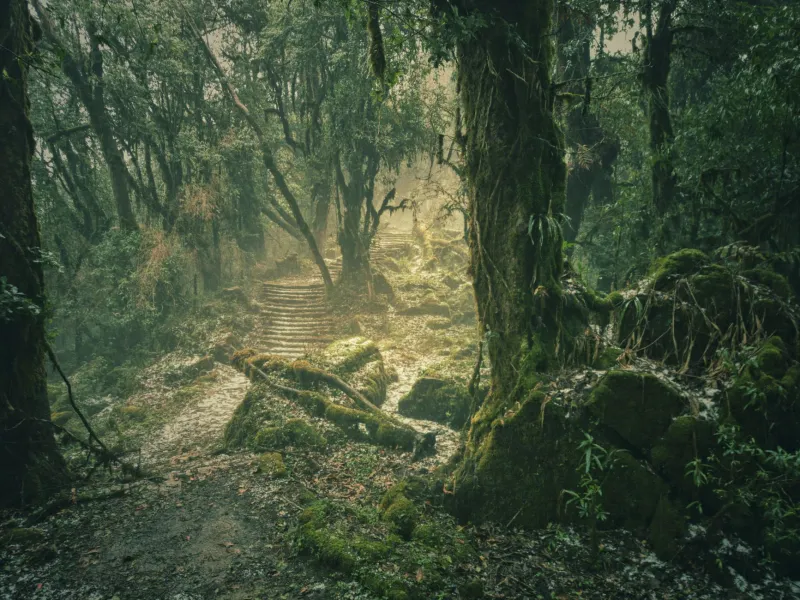
There is a peculiar sleight of hand that occurs at most contemporary gaming tables, one so normalized that many players have stopped noticing it entirely. The party departs the city. The Game Master describes a few days of travel—perhaps a brief atmospheric sketch of rolling hills or a fog-draped forest—and then announces, almost apologetically, that the group arrives at the dungeon entrance. The wilderness, that vast and theoretically perilous expanse between civilization and adventure, has been reduced to a caption.
This is not a failure of imagination. It is, more precisely, a failure of design philosophy. Modern campaign frameworks—and the published adventure paths that have come to define mainstream tabletop play in the United States—treat overland travel as connective tissue, a narrative bridge whose only purpose is to deposit characters at the next meaningful location. The result is a generation of players who genuinely do not fear the road, because the road has never given them reason to.
That was not always the case.
What Early Editions Understood About the Wild
The wilderness in early tabletop roleplaying was not merely atmospheric backdrop. It was a resource drain, a clock, and a threat in its own right. Older editions of Dungeons & Dragons built exploration around systems that demanded active engagement: careful mapping of hex grids, rationing of torches and rations, meaningful chances of becoming lost in unfamiliar terrain. A party that wandered carelessly into the Adirondacks equivalent of a fantasy map did not simply arrive somewhere interesting—they risked starvation, exposure, and encounters with creatures whose encounter tables were calibrated not for story beats but for genuine lethality.
The philosophical underpinning was significant. Exploration was framed as a skill, one that rewarded preparation, lateral thinking, and respect for the environment. A ranger's tracking proficiency was not a flavor ability—it was survival infrastructure. A cleric's ability to create food and water was not a curiosity—it was a campaign-sustaining resource. Every class feature that touched the natural world had teeth because the natural world bit back.
The gradual erosion of these systems across successive editions was not malicious. It was, largely, a response to legitimate feedback about accessibility and pacing. Granular resource tracking frustrated newer players. Hex-crawl mapping sessions could consume hours without delivering the dramatic payoffs that dungeon delving promised. The solution—streamlining wilderness travel into narrative summary—solved those friction points while quietly eliminating something irreplaceable: the sense that the world beyond the settlement walls was genuinely, consequentially unknown.
The Three Pillars of Meaningful Exploration
Restoring wilderness to its proper role in your campaign does not require discarding modern design sensibilities or forcing your players through a semester of old-school hex mapping. It requires rebuilding exploration around three foundational principles: resource pressure, navigational stakes, and ecological coherence.
Resource Pressure means that travel costs something beyond in-game time. Food, water, spell slots, hit dice, torches, arrows—the specifics matter less than the underlying principle that the wilderness is a place of attrition. When a party departs a settlement, they should be making genuine decisions about what they carry, what they leave behind, and how long they can sustain themselves. Even a simplified tracking system—three resource categories, a daily consumption roll, a threshold at which exhaustion begins accumulating—transforms the journey from a formality into a strategic problem. Players who are genuinely worried about running out of clean water before they reach the next river crossing are players who are paying attention to the terrain.
Navigational Stakes mean that getting lost is a real possibility with real consequences, and that finding one's way is a meaningful accomplishment. This does not demand that every GM become a cartographer. It does demand that travel through unfamiliar wilderness carry some probability of deviation, delay, or disorientation. A simple system—a Wisdom-based navigation check at the start of each day, with failure introducing directional drift that compounds over time—is sufficient to make the party's ranger feel essential and the party's lack of a ranger feel like a genuine vulnerability. The map, when the players finally draw it accurately, becomes a trophy.
Ecological Coherence is perhaps the most undervalued of the three. The wilderness should behave like a place that exists independently of the party's presence. Predators hunt prey. Seasonal changes affect food availability and travel conditions. Territorial creatures defend ranges that the party may need to cross or circumnavigate. When the environment operates according to its own internal logic rather than as a series of GM-curated encounters, players begin to read the landscape—to notice that the absence of birdsong might indicate a large predator nearby, or that the unusual concentration of deer tracks suggests a water source ahead. Ecological coherence transforms the wilderness from a setting into a character.
Rethinking the Random Encounter
No single mechanic has done more damage to wilderness exploration's reputation than the random encounter table deployed without purpose. The horror-movie-monster-appearing-from-nowhere approach to wandering encounters trains players to treat the wilderness as an inconvenience generator rather than a living system. The fix is not to abandon random encounters but to redesign them around what they were always theoretically capable of providing: emergent story.
Effective wilderness encounter tables are ecological, not merely statistical. They reflect the region's food chain, its political tensions, its recent history. An encounter with a wounded wolf is not simply a combat opportunity—it is a question. What wounded it? Is that thing still nearby? A group of refugees moving against the party's direction of travel is not filler—it is intelligence, or perhaps a moral complication. Every entry on a well-designed encounter table should be capable of generating either a meaningful choice, a piece of world information, or a resource consequence. Preferably all three.
Consider also the concept of tiered encounters, in which the frequency and nature of encounters shift based on how far the party has traveled from civilization. The first day out from a major city should feel relatively safe—patrols, merchants, farmsteads. By the fourth day, the encounters should feel genuinely alien, reflecting a world that has not been shaped by human hands. That gradient communicates, mechanically and atmospherically, that the party is moving into territory that does not care whether they survive.
Making Players Care Again
The deeper challenge is not mechanical but psychological. Players accustomed to wilderness-as-fast-travel will initially resist systems that slow them down and cost them resources. The solution is to ensure that the wilderness delivers on its promise—that the danger is paired with genuine reward.
Discovery is the currency of exploration. A hidden valley that appears on no published map, a ruined waystation containing a fragment of pre-campaign history, a natural phenomenon that hints at the world's deeper cosmological architecture—these are the treasures that hex-crawl veterans remember decades after the session. They cannot be purchased in a dungeon. They exist only in the spaces that most campaigns skip over.
When your players understand that the wilderness holds secrets unavailable anywhere else, they will stop treating it as an obstacle and start treating it as a destination. The road will become interesting again. The loading screen will become a frontier.
And frontiers, as any dedicated fantasy enthusiast knows, are where the best stories begin.