The Art of the Deduction: Rebuilding Mystery Encounters Around Active Player Investigation
Somewhere in the evolution of modern tabletop design, the mystery encounter lost its teeth. What was once a scene requiring genuine intellectual engagement became a checklist: roll Perception, roll Investigation, receive exposition, proceed to the next room. The dice became a vending machine for information, and the players became passive recipients of a story the DM had already solved on their behalf.
This is not an accident. It is the cumulative result of design philosophy that prioritizes narrative momentum over player agency—a reasonable goal that, when applied without restraint, produces encounters that feel like cutscenes. Players sit at the table and watch their characters learn things, rather than doing the learning themselves.
Restoring genuine investigation to your table requires rethinking not just how clues are distributed, but what a clue actually is—and what it asks of the people who find it.
The Difference Between Information and Evidence
The distinction is foundational. Information tells players something. Evidence requires players to interpret something.
"You find a letter confirming the merchant was blackmailing the alderman" is information. The players receive a conclusion.
"You find a letter in the merchant's handwriting that references a meeting at the mill on the night of the solstice, addressed to someone identified only by a wax seal you have seen on the alderman's correspondence" is evidence. The players must connect it to something they already know, assess its implications, and decide what it means—or whether it means what it appears to mean.
This distinction matters enormously at the table. When players receive information, they nod and write it down. When players evaluate evidence, they argue, speculate, and invest. The latter is what genuine investigation feels like.
Clue Architecture: Planting Evidence Deliberately
The Three-Clue Redundancy Principle
Before designing any mystery encounter, establish the core facts the players need to discover in order to make progress. Then, for each core fact, plant at least three independent routes to that fact.
This is not generosity—it is structural integrity. A single clue pointing to a single conclusion creates a linear path that collapses the moment players miss the clue or interpret it incorrectly. Three independent routes to the same conclusion means that players who follow different investigative paths will converge on the same truth through different evidence—which is both more realistic and dramatically more satisfying.
The three routes should differ in type, not just location:
- Physical evidence (the boot print, the broken latch, the residue)
- Testimonial evidence (what a witness saw, what an informant heard, what a record contains)
- Logical evidence (what must have happened given the constraints of time, access, and motive)
Players who specialize in different approaches—the rogue who interviews sources, the wizard who examines physical traces, the paladin who reasons from principle—should each find a path to the truth through their preferred mode.
False Clues and Red Herrings: Use With Precision
False evidence is legitimate design, but it requires careful construction. A red herring that leads nowhere is a frustration. A red herring that teaches players something true about the world—even if it is not directly relevant to the mystery—is a characterization tool.
The merchant's secret correspondence might point toward an entirely separate scheme that is not the crime under investigation. Following that thread reveals something about the world's political landscape and rewards player curiosity, even as it confirms that the merchant is not the murderer. The players have not wasted their time; they have enriched their understanding of the setting while eliminating a suspect.
Avoid false clues that exist purely to obstruct. They teach players that investigation is unreliable, which is the opposite of what you want them to believe.
Managing Multiple Solution Paths
The most common anxiety among DMs designing mystery encounters is loss of control: what happens when players reach the correct conclusion through reasoning the DM did not anticipate?
The answer is: you confirm it, and you remember it as a success.
A mystery encounter is not a test of whether players can find the path the DM designed. It is a test of whether the players can reason their way to a true conclusion. If a player synthesizes two pieces of evidence in a way you did not foresee and arrives at the correct answer, that player has done exactly what investigation is supposed to accomplish. The fact that the deductive path was unexpected is irrelevant—the conclusion is sound.
This requires DMs to be clear, in their own preparation, about what is actually true in the scenario—not just what the prepared clue trail suggests. When you know the ground truth, you can evaluate any player-generated hypothesis against it and respond honestly.
The Hypothesis Board
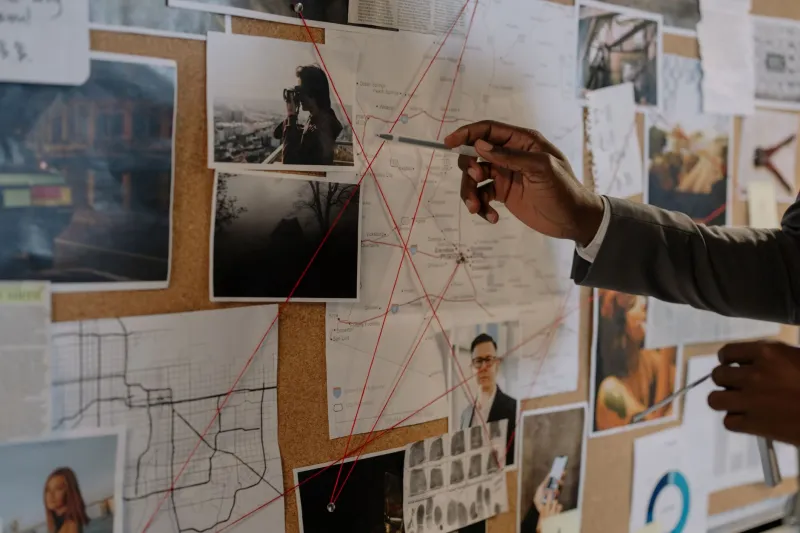
For extended mystery scenarios, consider introducing a physical or digital hypothesis board—a shared space where the party tracks clues, suspects, and working theories. This can be as simple as an index card system or a shared online document.
The hypothesis board does several things simultaneously. It externalizes the investigation, making player reasoning visible and discussable. It prevents the common failure mode where one player holds all the information in their head and others disengage. And it gives the DM a clear view of where the party's reasoning currently stands—which is essential for calibrating what to reveal next.
Rewarding Ingenuity Without Railroading
The central tension in mystery design is between rewarding player cleverness and ensuring the story can progress. Too rigid, and players who miss a clue are permanently stuck. Too accommodating, and the mystery dissolves into the DM simply telling players what they want to know whenever they ask.
The resolution lies in distinguishing between what players discover and how they discover it. The destination—the truth of what happened—should be fixed. The path to that destination should be genuinely open.
When players are stuck, the appropriate DM response is not to hand them the answer but to activate a new route to existing evidence. A witness they have not yet interviewed comes forward. A document they overlooked becomes relevant due to a new development. The world continues to move, and that movement surfaces information organically rather than through DM fiat.
The Player's Role: Investigation as Active Practice
Finally, genuine investigation requires something from players that passive information delivery does not: they must think on screen. They must voice hypotheses, accept the possibility of being wrong, and commit to following logic even when it leads somewhere uncomfortable.
This is a table culture question as much as a design question. DMs who want investigation to function should make explicit, ideally at session zero, that the game rewards reasoning rather than dice rolls—that a player who constructs a well-evidenced argument for a conclusion will receive confirmation or meaningful pushback, regardless of what the dice say.
Investigation, properly designed, is one of the most satisfying experiences a tabletop session can offer. It asks players to be present, engaged, and genuinely clever—and it rewards them with the particular satisfaction of a conclusion that they earned, not one that was handed to them.