Storm the Campaign: Designing Weather Systems That Drive Story, Not Just Scenery
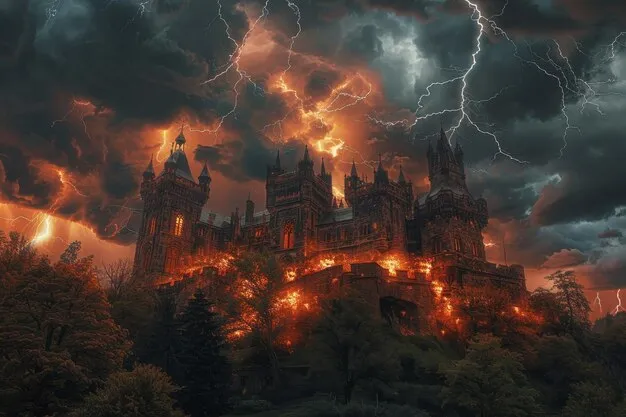
Photo: dramatic fantasy storm dark clouds lightning over medieval castle landscape, via img.freepik.com
Ask most Game Masters how they handle weather, and the answer follows a familiar pattern. A brief description sets the scene—perhaps a gray sky overhead or a chill in the morning air—and then the session moves on to what everyone actually came for: the dungeon, the negotiation, the ambush. Weather exists as texture, not substance. It decorates the world without shaping it.
That is a significant missed opportunity.
When weather carries mechanical weight, it stops being scenery and starts being story. Storms delay supply caravans. Droughts destabilize grain-dependent kingdoms. A blizzard forces an unlikely alliance between enemies caught on the same mountain pass. These are not contrived plot devices—they are the natural consequences of a world that breathes, cycles, and occasionally turns hostile. This guide is for worldbuilders and Game Masters who want their meteorology to matter.
The Problem with Flavor-Only Weather
The instinct to treat weather as pure description is understandable. Sessions are already dense with mechanical decisions, and adding another layer risks overwhelming both the GM and the players. But flavor-only weather creates a subtle problem: it signals to players that the physical world is inert. If rain never affects movement, if cold never drains resources, if wind never disrupts ranged attacks, then players learn to ignore the environment entirely. The world becomes a painted backdrop rather than a living system.
This matters beyond mere verisimilitude. When players cannot meaningfully interact with their environment, they lose a whole category of problem-solving. Weather-as-mechanic opens doors that weather-as-flavor permanently closes.
Building a Regional Weather Framework
Before introducing weather mechanics at the table, a worldbuilder needs a coherent geographical foundation. Weather does not occur randomly—it follows terrain, season, and latitude with rough consistency. A coastal region experiences different patterns than an inland steppe. A mountain range creates rain shadows. A desert bakes under predictable sun.
Start by sketching a climate map alongside your political map. Assign each major region one of four broad climate archetypes: temperate, arid, arctic, or tropical. These archetypes do not need scientific precision—they need enough internal logic to make weather feel earned rather than arbitrary.
From that foundation, define a seasonal cycle. Four seasons work well for most campaigns because they carry strong cultural resonance for American players accustomed to distinct seasonal shifts. Assign each season a dominant weather tendency per region: spring floods in the river valleys, summer droughts in the southern plains, autumn storms along the coast, winter passes closing in the highlands. Now weather has a calendar, and that calendar has consequences.
Mechanical Integration Without Mechanical Overload
The most common reason GMs avoid weather mechanics is complexity. Nobody wants to pause a tense encounter to consult three separate tables. The solution is to build weather effects that are few in number, easy to reference, and genuinely impactful.
Consider organizing weather effects into three tiers based on severity.
Mild conditions—light rain, moderate wind, overcast skies—impose minor situational penalties. Perception checks at distance become slightly harder. Fires require extra effort to maintain. Tracks wash away faster, complicating pursuit. These effects are easy to remember and require no table consultation.
Severe conditions—heavy storms, blizzards, extreme heat—impose meaningful mechanical costs. Movement rates drop. Concentration checks for spellcasters become harder as cold, wind, or rain batter their focus. Ranged attacks suffer significant penalties. Exposed characters accumulate exhaustion. At this tier, weather becomes a resource management challenge: do the players push through, or do they shelter and lose time?
Catastrophic conditions—hurricanes, flash floods, volcanic ashfall—function as set-piece encounters in their own right. Navigation fails. Visibility drops to near zero. Survival becomes the immediate goal. These events should be rare and telegraphed, but their arrival should feel genuinely threatening.
Weather as Political Catalyst
Some of the richest storytelling potential in weather systems lies not at the encounter level but at the campaign level. Meteorology shapes economies, and economies shape politics.
A prolonged drought does not merely inconvenience travelers. It withers harvests, raises food prices, empties granaries, and generates exactly the kind of desperation that topples governments or ignites wars. A kingdom dependent on river trade loses leverage when an early freeze locks the waterways for an extra month. A coastal city-state built on fishing finds its fleet grounded—and its treasury—when hurricane season arrives earlier than expected.
These macro-level consequences give weather a political dimension that players can engage with directly. Perhaps the party is hired to escort grain shipments through dangerous territory because the drought has made those shipments worth protecting. Perhaps a noble is engineering water rights disputes that the players must navigate. The weather itself becomes a faction of sorts—an impartial force that every political actor is scrambling to respond to.
Building two or three weather-driven political pressures into your campaign background before the first session ensures that when a drought hits, it lands with context and consequence rather than as a surprise GM invention.
Spellcasting in Hostile Skies
Magic systems interact with weather in ways that most rulebooks underexplore. Consider the narrative and mechanical possibilities. A storm is not merely an obstacle for a wizard—it is a potential amplifier. Lightning-based spells might carry bonus effects during thunderstorms. Water magic could be dramatically more potent during monsoon season. Conversely, fire magic might struggle in torrential rain, and wind spells might become dangerously unpredictable in a gale.
These interactions do not require elaborate subsystems. A short list of elemental affinities and weather modifiers—kept on a single index card—gives spellcasting players interesting choices without slowing the session. More importantly, it makes magic feel embedded in the natural world rather than hovering above it.
Giving Players Agency Over the Forecast
Weather systems work best when players can interact with them rather than simply endure them. A ranger with deep wilderness expertise should be able to read incoming weather and warn the party. A druid should have meaningful ability to influence local conditions. A merchant character might invest in weather-prediction services that provide in-world intelligence about seasonal patterns.
These options transform weather from a GM-imposed obstacle into a collaborative element of play. Players who can anticipate, prepare for, and occasionally manipulate weather conditions feel genuinely embedded in the world. The storm becomes their story, not something happening to them.
Putting It All Together
Implementing meaningful weather does not require rebuilding your campaign from the ground up. Start small: choose one region, assign it a seasonal pattern, and introduce one severe weather event with real mechanical stakes during your next session. Observe how players respond. Most groups, given a genuine environmental challenge, rise to it with creativity and engagement.
From that single experiment, expand outward. Build the climate map. Add the political pressures. Develop the elemental affinities. Over time, weather becomes one of those campaign elements that players reference long after the session ends—not because it was dramatic set dressing, but because it genuinely changed what they had to do.
A world that rains is a world that lives. Give your campaign the forecast it deserves.